Showing posts with label rise. Show all posts

Friday, June 26, 2009

Best Dissertation Award


In the last Brazilian Symposium on Software Quality, Fernando Raposo, member from the RiSE Labs was awarded with the best M.Sc. dissertation in the software quality area.

In his work, Fernando defined an approach for component testing and a CASE tool to automate it. Moreover, he defined an experimental study evaluating the approach and tool defined.

Congratulations, Fernando!!

Sunday, November 30, 2008

2nd RiSS - RiSE Summer School

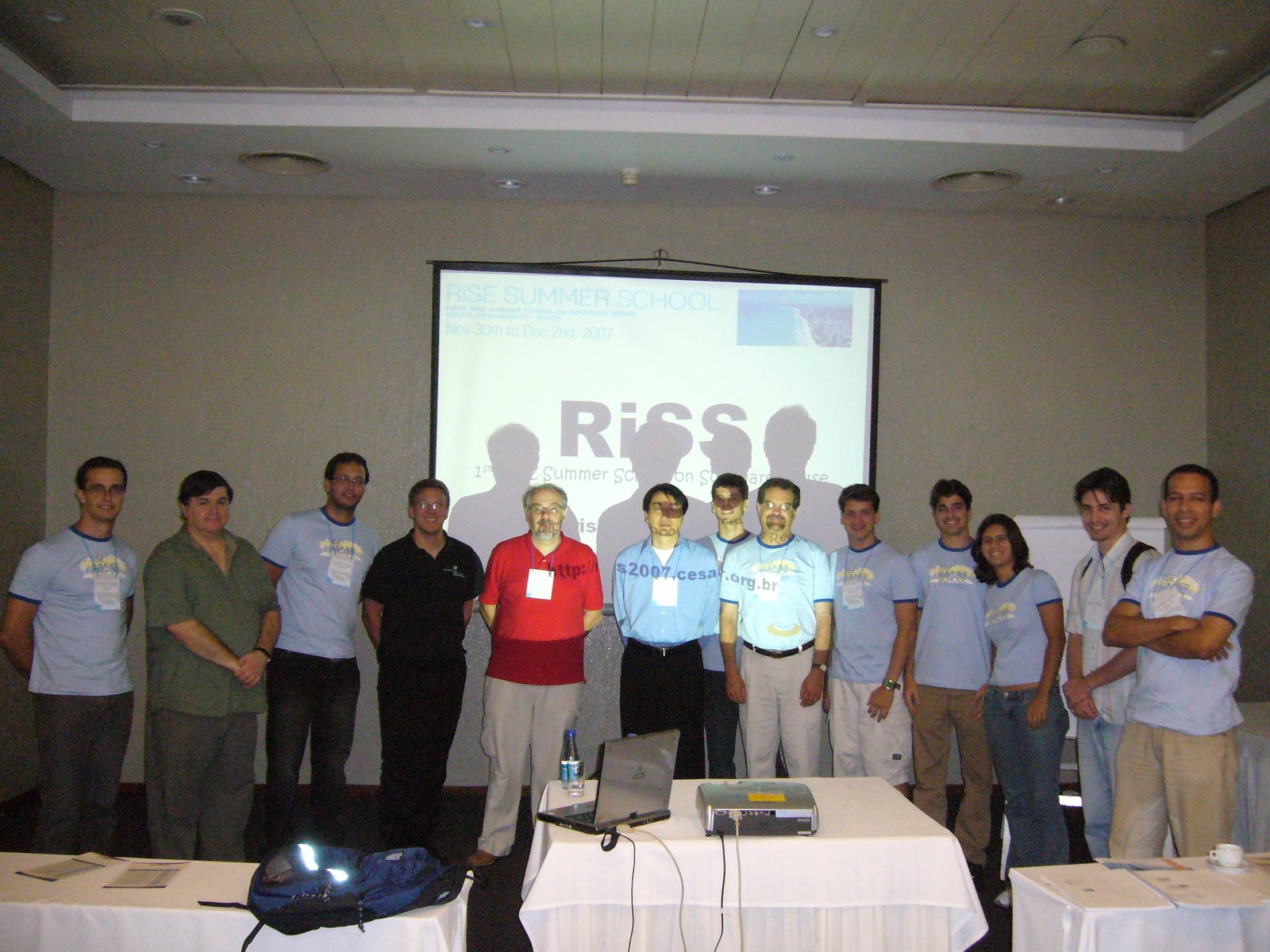
In the last year, we created RiSS - RiSE Summer School on Software Reuse. The main goal of RiSS is to discuss the main software reuse issues with the main experts in the field from industry and university. In this year, we had the second edition and I believe that the summer school was very nice. In the program, a full discussion about software product lines, the main topic on the software reuse area. As lecturers, we had experts from industry and university from several countries around the world. This mix is part of the RiSS successful.

In this year, we had five lecturers, one Workshop on Software Reuse Efforts and an awesome panel with the lecturers answering questions from the attendants.

During three days, we were in front of the sea as you can see and with a full room composed of 100 people interested on the topic.
In this year, we had the award again for the best lecture and Paul Clements joined to Wayne Lim with the best presentation about product line architecture.


In name of the organization, I would like to say thank you for the participants, lecturers, and authors.

See you next time!!

One more Unforgettable RiSE Day

On November 26th, we had at C.E.S.A.R one more RiSE Day. This special workshop was composed of many discussions involving too many different issues in software reuse. In this edition, we had invited participants:Klaus Schmid, Kyo Kang, Rob Ommering, and Michalis Anastasopoulos.

The great agenda started with an overview about RiSE Labs and continued with the presentations about product lines, service-oriented product lines, bug triage and rise tools. Every year, I believe that this workshop is getting better.

Thanks for all the students and the invited participants for valuable feedback and patience.

Saturday, April 19, 2008

21st IEEE Conference on Software Engineering Education and Training (CSEE&T)

Last week, I participated in a good conference the 21st IEEE Conference on Software Engineering Education and Training (CSEE&T). I said good because in this conference there was 3rd Academy for Software Engineering Educators & Trainers (ASEE&T). I did not know both and especially the second was incredible. Incredible because we have lectures with Barry Boehm, Victor Basili e Dieter Rombach. That was very nice. The slides are there. You can see it.

About CSEE&T, it was very good also. It is a good conference to discuss about software engineering education and training in general. There, we had discussions about games in software engineering, agiles and formal methods, etc. The keynote speakers included Bertrand Meyer and Watts Humphrey.

I was there presenting part of our experience teaching software reuse with the paper: A Case Study in Software Product Lines: An Educational Experience. It, in general, was well received by the software engineering education community with some questions. Next year, the conference will be in India.

Monday, April 14, 2008

Microsoft Research Fellows - RiSE's member is there


One more time, it is a day to celebrate in RiSE. One member of our staff, Daniel Lucredio, was awarded to Microsoft Research. Daniel is going to California this year to spend some months there as a researcher. The entire RiSE is proud of it.

Good luck there, Daniel.

Monday, February 18, 2008

Reuse in Software Engineering (RiSE) - The New Face

Today, is one more day to celebrate. The Reuse in Software Engineering (RiSE) launched its enterprise website. It is one more step towards the world-wide market. In the new website, you can see the new logo, information about our products and services (consulting and training), feedbacks from the main reuse specialists around the world from industry and university, our customers, partners, videos, and etc.

Enjoy the new website and next features are coming. Credits for our new member Robson Ribeiro design engineer responsible for the website. Send us your feedback also, please!

Friday, February 8, 2008

Ingredients for Reuse Introduction: Make your Mix

In several talks which I have given, different attendants have asked me about how to introduce reuse in companies. At the RiSE, we have many papers and seminars about reuse introduction, reuse maturity models, frameworks, tools, etc. But, the main question often is: what are the ingredients to perform it?

During the First RiSE Summer School on Software Reuse (RiSS), we had some interviews with the keynotes speakers about this aspect too. In this post, I will not concentrate in academic references or papers. You can read some of them here or with other researchers such as Bill Frakes, Maurizio Morisio, Jeff Poulin, Ruben Prieto, Martin Griss, Wayne Lim, Will Tracz, etc.

First of all, your CEO or Top Manager should be convinced that reuse can be a good way for your organization to improve the time-to-marketing, quality and reduce costs. It is necessary because they will send this message for all the organization. It happens often in quality programs, for example. In addition, I believe that all the organization should understand and believe in this idea, i.e., the culture should be spread from project managers until software engineers. Otherwise, this effort cannot work properly. But just understand and accept the idea is not enough. We need to train the necessary staff to introduce reuse. In some cases, the people need to know what can help, what are the available techniques, tools and metrics. With people convinced/motivated and trained, I think that is also important to have a reuse plan. It is necessary for the reuse team as well as for the CEO because you should show clearly the steps to introduce reuse, the milestones, the risks, the costs, the benefits, i.e., you should show that the approach is systematic with a defined begin-end cycle.

So, in this path, a pilot project based on a specific domain or not should be considered to show it. For this pilot, the plan can address to analyze applications in the organization [what is common and variable, profile of the developed software], change or adapt the current process, collect other data, define some [specific] tools and track the pilot. It working well is time to analyze the pilot, understand the problems and strong points, learn with the process, present the results for the sponsors, and spread it for more areas in the organization.

Monday, December 3, 2007

RiSE Summer School (RiSS) - Final Remarks

Yes, yesterday the RiSE Summer School – the first event around the world in this direction - came to its end. The event could put together the main names from industry and university together. During these days, Ivica, Frakes, Dirk, Wayne, Prieto and Krueger were incredible. In the second day, Dirk showed all his experience working with software product lines. It is incredible his experience and advances in the field. This guy is doing an incredible work in the field. After that, the show man, Wayne Lim, started a historical talk in software reuse. Wayne divided the room in a new shape and simulated a practical case study with roles and points of view. Wayne was brilliant.

In the last day, Prieto discussed his ideas about libraries, facets and their evolution into ontologies. After that, Krueger started his presentation. Krueger was incredible. He could show how a CEO can do a nice talk and present his product in a hands on way. Krueger was also very impressive. I think that he could discuss for all night.

After the talks, the awards were announced. The first one was the Reuse Guy. Ricardo Cavalcanti, software engineer at C.E.S.A.R, was incredible. This guy had several questions during all the talks and was awarded by audience and organizers. In the second one, Wayne Lim, was awarded with the best course in the summer school. Wayne was incredible and had incredible acceptance by the attendants.

If you did not have opportunity to be there, in the next week we will publish the videos and interviews during the conference. If you were there, it is time to remember more.

Friday, November 30, 2007

1st Day RiSE Summer School - RISS 2007

Today was the first day of the RiSE Summer School (RISS). The auditorium was completely crowded and the people very interested in the topic. We had attendants from different parts in Brazil from companies and universities. There, students, professors, researchers and practitioners had the first two courses. The first one was with Ivica Crnkovic. Ivica performed a very important talk on CBD with his experience in the field. He discussed definitions, principles, processes, etc. After that, Bill Frakes started the presentation about domain engineering. Bill achieved a very nice talk clarifying some concepts in the area, directions for research, and incredible reuse koans.

All the material will be published on the internet (here), in conjunction with the video of the presentations.

Celebration - Latin American Fellowship Program:: Microsoft Research

Tonight, we received one more very nice confirmation. I am very pleased to announce that the selection process for the Latin American Fellowship Program at Microsoft Research in Redmond has been completed and Daniel Lucredio RiSE member - has been selected as a new Fellow at Microsoft Research, the most prestigious student award.

His mentor there will be Dr. Ethan Jackson from the Foundations of Software Engineering group. Nowadays, Daniel is doing his Ph.D. sandwich at George Mason University. In this time, the entire RiSE staff in Brazil congrats him for it.
Congratulations and let’s have more champagne.

The First Historical RiSE Day

Can you imagine an internal workshop with Bill Frakes, Dirk Muthig, Ivica Crnkovic, Wayne Lim, and Ruben Prieto-Diaz with several discussions about search and retrieval, software product lines, reuse tools, repository bugs, and software reuse at all?

If your answer was yes, that is it. It was the RiSE Day which happened on November, 29, 2007. It was incredible with different point of views and exciting talks with the B.Sc., M.Sc., and Ph.D. students in RiSE.

Thanks for all the students and the keynotes for valuable feedback and patience. See all the pictures and presentations here.

Tuesday, November 13, 2007

RiSE’s Podcasts: Episode 1 – Software Product Lines with Dr. David Weiss

Today, the RiSE starts a new source of information in the software reuse area: PodCasts with interviews involving the main practitioners/researchers working with software reuse. It was inspired in the software engineering radio and a talk with Dr. Uira kulesza new professor at C.E.S.A.R EDU.
To begin, our first guest is Dr. David Weiss, research director at Avaya Labs, and our partner. Dr. David Weiss is a researcher and practitioner in the area working with Software Product Lines. In this area, Dr. Weiss is the chair of the Hall of Fame, one of the most important sessions with practical efforts in reuse. In the research world, Dr. Weiss has a strong experience being creator of important advances in the process and measurement fields.
In this interview, Liana Barachisio, software reuse researcher at RiSE, presents ten important questions involving reuse. Listen the interview here.

Thursday, November 8, 2007

Celebration - CRUISE book - Part II

The celebration for the CRUISE book was very nice. There, we had a video with our chief scientist and RiSE's coordinator, professor Silvio Meira. Next, Eduardo Almeida presented an overview about the RiSE. Finally, after the talks and questions by the attendants composed of professors, CEOs, academic directors, students, friends, and relatives, we had an excellent cocktail with drinks, foods, and good conversations.


In the picture, we have some authors: Vinicius Garcia, Alexandre Alvaro, Eduardo Almeida, Leandro Marques, and Vanilson Burégio. The other ones, Silvio Meira, Jorge Mascena, and Daniel Lucrédio were in meetings in other states with government authorities (Silvio Meira) and living in U.S. (Jorge Mascena and Daniel Lucrédio).


At the end, all the authors and the RiSE's staff (in the picture), would like to thank all the people, especially, Veronica Lemos our marketing partnership at, C.E.S.A.R, and the Livraria Cultura.


Cheers!!

Tuesday, November 6, 2007

Celebration - CRUISE book


Tonight, we celebrate: The CRUISE book will be released - printed copy - at Livraria Cultura in Recife, Perbambuco, Brazil, after more than 2000 downloads on the web. Everyone is invited to enjoy the night with the authors who will sign the copies.

Monday, September 17, 2007

RiSE members visit Virginia Tech in Falls Church

On Friday, September 14th 2007, me (Liana Barachisio) and Daniel Lucrédio visited the Virginia Tech building in Falls Church, VA, to have a meeting with professors Bill Frakes and Gregory Kulzczycki. They briefly discussed their current research works, on formal methods being applied in reengineering, domain engineering (DARE process), tests, COTS, object-oriented metrics and code generation.

We also presented RiSE's works, like the Reuse Maturity Model, the Model Driven Reuse approach, component certification and testing and the RiSE tools – B.A.R.T., CORE, ToolDAy and LIFT. They were particularly interested in Lift, which is a tool for retrieving legacy systems information, aiding the system documentation, because of its results in a real project, and also because they are currently working with reengineering themselves.

Frakes was also interested in B.A.R.T.'s query reformulation work. Regarding the ToolDAy, even though the adopted process is different from DARE's, he liked to see that the tool is well developed and assembled, and said that DARE could use some of improvement in this aspect.

Frakes also gave us a more detailed presentation about the DARE environment. He also presented the main concepts and current trends on software reuse, and we were pleased to see that RiSE has relevant works in most of them.

Besides getting to know each other's works, another goal of this meeting was to find options for possible cooperations between RiSE and their research group at Virginia Tech. One of the suggestions is to pursue co-founded projects between us; another option is to send Ph.D. and M.Sc. students to Virginia Tech, to exchange ideas and experience, and vice-versa; we also discussed the possibility of joint development and tool integration. Since one of RiSE's goals is to develop practical tools for reuse, we could benefit from the experience of both groups to deliver good solutions to the industry.

The meeting ended with many possibilities, and the next step is to start defining concrete options and suggestions to make this collaboration happen.

C.E.S.A.R and Avaya Labs started cooperation

The Recife Center for Advanced Studies and Systems (C.E.S.A.R) and Avaya Labs (U.S.) started an agreement for cooperation in the next three years involving efforts in the software reuse area. The agreement defined by the Reuse in Software Engineering (RiSE) group – reuse group from C.E.S.A.R – and the research director from Avaya, Dr. David Weiss, started with a project in the software reuse tools area.

In this project, Liana Barachisio, software engineer and software reuse researcher at C.E.S.A.R, moved to Avaya Labs during five weeks to work together with Dr. David’s team. In this project, C.E.S.A.R and Avaya are identifying requirements for a software product line automation tool based on Avaya’s process.

The idea is to participate on the development of an artifact in the software product line as a way to understand the process’ guidelines. Therefore, a better know-how can be taken to C.E.S.A.R., whose software product line area is starting. After that, a comparison can be done between Avaya’s consolidated software product line process and the one being applied in C.E.S.A.R., with the goal of identifying possible improvements in both sides.

Tuesday, September 11, 2007

RiSE publishes a survey about software reuse in the Brazilian industry scenario

The paper entitled "Software Reuse: The Brazilian Industry Scenario", authored by Daniel Lucrédio, Kellyton Brito, Alexandre Alvaro, Vinicius Garcia, Eduardo Almeida, Renata Fortes and Silvio Meira, will be published in the Journal of Systems and Software, one of the world's most important vehicles in the Software Engineering area. The study analyzed 57 small, medium and large companies in the country, with the objective of identifying the decisive factors for adopting a software reuse program. The study aimed at answering the main doubts and concerns of the companies seeking to promote software reuse.


Similar studies were already conducted in other countries, including surveys from Bill Frakes, from VirginiaTech, Maurizio Morisio, from Politecnico di Torino and David Rine, from George Mason University. Now, with this survey from the RiSE group being published, the Brazilian scenario begins to figure as an important part of the reuse literature, serving as basis for other reuse researchers and practitioners.

Tuesday, September 4, 2007

What should Model-Driven Reuse look like?

Eclipse's GMF project has just reached version 2.0 in June, 2007. After more than 2 years of development and presentations at ECOOP 2006 and OOPSLA 2006, among others, the project has reached the necessary stability to start being used in the industry. Having developed a modeling tool myself, I was really impressed with the level of details that is possible to achieve with GMF. Of course, I was also amazed with the fact that the work that took approximately 6 months of my M.Sc. can now be done in 15 minutes. When combined to a code generation framework, such as JET, the possibilities are literally endless. With not so much training, most developers can start creating their own modelers and generating Java, C#, VB, Javascript, XML, and other kinds of source code.

This is, from my point of view, the major achievement of these two particular projects. Code generation and domain-specific modeling are no longer technologies restricted to extremely highly skilled (and expensive) employees, researchers or companies. Maintaining modelers and generators does not require months of planning and implementation, but can be done directly by the developers.

This is where the problem begins. The most obvious (at least for me) application for this technology is to improve software reuse using product families/domain engineering ideas. Therefore, what is the best way to combine software reuse technology (components, repositories, design patterns, product lines, domain engineering, certification, ...) with model-driven development technology (platform-independent models, platform-specific models, model-to-text transformations, model-to-model transformations, ...) ?

The best starting point for answering this question is the modelware initiative. Several research groups and companies are gathered around different areas, having already delivered interesting reports, including a MDD Maturity Model and a MDD Process Framework. However, these not only fail to include specific reuse concern, but are also more suited for european companies, which already have MDD in their knowledge base.

Thinking about introducing these technologies from scratch, we from the RiSE group are developing a model-driven reuse approach, including the needed activities and guidelines. Initial focus is being placed on engineering-related activities, and mainly in the implementation phase, with code generation and platform-specific modeling. The following figure shows a preliminary draft, showing three basic cycles.

The basic cycle is domain engineering, which is being represented as the RiDE (Rise process for Domain Engineering) approach. Based on the results of the domain design phase, the modeler engineering cycle begins. This is where a domain-specific modeler is developed, based on the domain's architecture's elements, such as variability points and architectural patterns.

During domain implementation, components are developed and the transformation engineering cycle starts. This cycle is responsible for developing transformations to be used together with the domain-specific modeler. A design by-example approach is used.

The result of these cycles includes not only source code components, but also transformations that can be used to generate parts of the final product. For example, some specific components may be handcrafted, while controller components and basic infrastructure code can be generated. One practical example is the Web Domain. Specific components for building dynamic web pages, such as a dynamic list or a date picker component, may be handcrafted, while the navigation code, such as Struts's descriptor file, can be generated from a web navigation modeler.

According to Modelware's MDD Maturity Model, the next step regarding the engineering perspective is to incorporate MDD up in the analysis and design phases, allowing the domain engineer to benefit from model-to-model transformations to generate parts of the design or to automatically apply design patterns, performing some kind of model refactoring.

However, the terrain is a little more obscure in these cases than in the implementation. The problem here, I think, is not even the lack of tools, because there are model-to-model transformation engines based on eclipse and EMF available, such as ATL, which have already been tested and proven to be practical. For me, the problem is that the kind of work that is performed during analysis and design is much more conceptual, and therefore, more likely to be erroneously performed by non-human workers, such as a computer-based transformer.

Therefore, except for some basic helper refactoring-like transformations, I think that the use of MDD in these higher-level models will still have to wait some years before reaching the same levels of automation that we can now use in implementation.

Tuesday, August 21, 2007

1000th Goal


Yes, Better Late Than Never. In the same way such as Pele and Romario, the C.R.U.I.S.E book, the first one on software reuse, published by the RiSE group, at C.E.S.A.R, passed more than 1000 downloads. The awarded reader was Ryan Bagueros, software engineer in San Francisco, U.S.

It is a milestone to celebrate. The book published on April 2007 has downloads from several countries including: U.S., India, England, Canada, France, China, Japan, among others.
If you have a copy, send it for other interested people and help us to increase the reuse community. If you do not have, get your copy here!!